
This report is taken from PN Review 290, Volume 52 Number 6, July - August 2026.
Letter to architect John Scott on the occasion of the reroofing of Futuna Chapel
I
John, your tribe of ducks
is soon enough back
on the adjacent lawn
as though they never left – single-file,
a project-managerial air
about them, asserting a kinship
with your chapel
in the brightness of its plumage,
the fresh weave of its roofing.
An albatross, a swan…
‘Can’t you see,’ asked a small boy
called Blessing, ‘the wings of this,
our great, diving bird?’ We were standing
outside the chapel of Futuna
where, last visit, the tilers
were themselves scattered like birds on the roof
and the building wrapped
in fabric whiteness. Scholars lost
in their signatures, these quiet,
concentrated roofers
following the contours
of their ceramic sky.
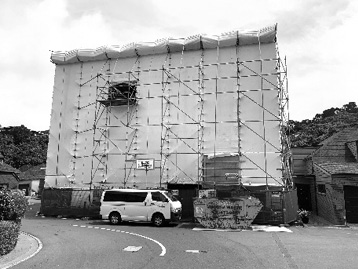
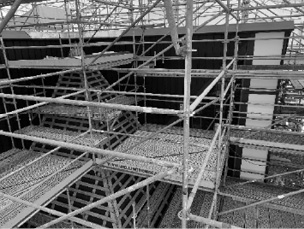
It was nothing I have ever seen –
the enshrouded air
with its walkways, platforms,
trapdoors, the deftly engineered sunrise
in its far room. And a chair,
always a chair,
placed for the morning light. That is where
we best remember you, John.
Or up here
in the middle air
all of us above our station,
next level, heart flutter,
looking down on ourselves.
II
Sky-adjusted, weather-attended
this bird-scaffolding or cage
with its cloud congregation
and the Wellington wind which is never without
an opinion. Such a thing.
All our ideas, concluded Wallace Stevens,
come from nature. Umbrellas
were derived from trees
and so our bird-chapel
might once have been
a crown of thorns or sunflower
sea star. And its whiteness
poplar fluff or Haumoana moth plant.
In natural history, as in
ornithology, the chapel might
lose itself:
among weight-bearing clouds,
or, on a windy day, following the paperwork,
but only
as far as it goes. Because, as Blessing tells me,
words never
reroofed a cathedral.
Such structural concerns, John, I need not remind you.
III
And now to behold this, your handiwork,
as many hands have upheld it,
in our now completed
chapel of the middle air,
a weightlessness more
hummingbird
than spinning top.
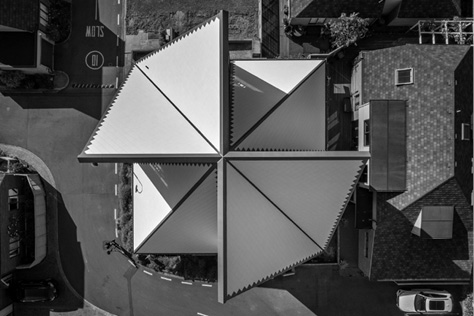
Of sea salt and sloping
luminescence, the morning roof plane
might as easily be
the lop-sided, bird-speckled beach at Futuna Island,
tilted sunward, the bright face
upon which we now
lurch, plane and bevel,
and sail past
last summer’s flapping,
howling tympanum. Somehow
all things considered,
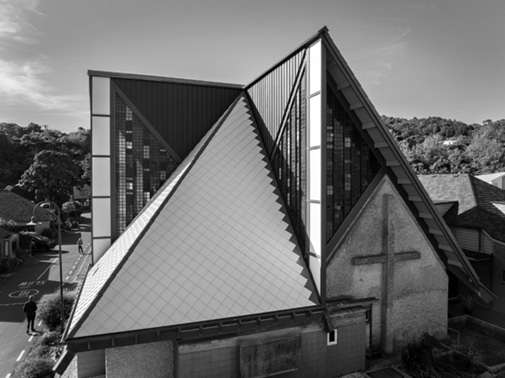
this once endangered bird
has nested here,
its cantilevered heart
caught
in perpetual updraft,
crossbeams and lintels of
this lasting attachment,
arms of the outstretched. Such a thing.
(Sixty-fifth anniversary of Futuna Chapel, 19 March 2026)
Designed by architect John Scott (1924–92), of Māori, Scottish and Irish descent, and opened in March 1961, Futuna Chapel, in the Wellington suburb of Karori, was constructed by six Marist brothers with virtually no building experience between them and only one piece of electrical equipment – a drill – on site. Almost at once, it was acknowledged as a seminal building in New Zealand’s architectural history. In the 1990s the original asbestos roof was removed and replaced with nondescript bitumen tiling; the recent reroofing (using Italian-made ceramic tiles) has restored the chapel to its original glory. No longer a functioning place of worship but overseen by a charitable trust (on which the poet has been a trustee for fifteen years), the chapel is considered by many the greatest expression of New Zealand/Polynesian architecture to date. Recently a travel writer in Time Out (UK) included Futuna in a listing of the twenty-four most beautiful buildings in the world.
‘Letter to John Scott’ was read at Futuna Chapel on 21 March 2026, to mark the sixty-fifth birthday of the building and the ‘unveiling’ of the roof. (https://futunatrust.org.nz/)
Photographs courtesy of the Futuna Trust (1 & 2 by G. O’Brien; 3 & 4 by Paul McCredie)
John, your tribe of ducks
is soon enough back
on the adjacent lawn
as though they never left – single-file,
a project-managerial air
about them, asserting a kinship
with your chapel
in the brightness of its plumage,
the fresh weave of its roofing.
An albatross, a swan…
‘Can’t you see,’ asked a small boy
called Blessing, ‘the wings of this,
our great, diving bird?’ We were standing
outside the chapel of Futuna
where, last visit, the tilers
were themselves scattered like birds on the roof
and the building wrapped
in fabric whiteness. Scholars lost
in their signatures, these quiet,
concentrated roofers
following the contours
of their ceramic sky.
It was nothing I have ever seen –
the enshrouded air
with its walkways, platforms,
trapdoors, the deftly engineered sunrise
in its far room. And a chair,
always a chair,
placed for the morning light. That is where
we best remember you, John.
Or up here
in the middle air
all of us above our station,
next level, heart flutter,
looking down on ourselves.
II
Sky-adjusted, weather-attended
this bird-scaffolding or cage
with its cloud congregation
and the Wellington wind which is never without
an opinion. Such a thing.
All our ideas, concluded Wallace Stevens,
come from nature. Umbrellas
were derived from trees
and so our bird-chapel
might once have been
a crown of thorns or sunflower
sea star. And its whiteness
poplar fluff or Haumoana moth plant.
In natural history, as in
ornithology, the chapel might
lose itself:
among weight-bearing clouds,
or, on a windy day, following the paperwork,
but only
as far as it goes. Because, as Blessing tells me,
words never
reroofed a cathedral.
Such structural concerns, John, I need not remind you.
III
And now to behold this, your handiwork,
as many hands have upheld it,
in our now completed
chapel of the middle air,
a weightlessness more
hummingbird
than spinning top.
Of sea salt and sloping
luminescence, the morning roof plane
might as easily be
the lop-sided, bird-speckled beach at Futuna Island,
tilted sunward, the bright face
upon which we now
lurch, plane and bevel,
and sail past
last summer’s flapping,
howling tympanum. Somehow
all things considered,
this once endangered bird
has nested here,
its cantilevered heart
caught
in perpetual updraft,
crossbeams and lintels of
this lasting attachment,
arms of the outstretched. Such a thing.
(Sixty-fifth anniversary of Futuna Chapel, 19 March 2026)
Designed by architect John Scott (1924–92), of Māori, Scottish and Irish descent, and opened in March 1961, Futuna Chapel, in the Wellington suburb of Karori, was constructed by six Marist brothers with virtually no building experience between them and only one piece of electrical equipment – a drill – on site. Almost at once, it was acknowledged as a seminal building in New Zealand’s architectural history. In the 1990s the original asbestos roof was removed and replaced with nondescript bitumen tiling; the recent reroofing (using Italian-made ceramic tiles) has restored the chapel to its original glory. No longer a functioning place of worship but overseen by a charitable trust (on which the poet has been a trustee for fifteen years), the chapel is considered by many the greatest expression of New Zealand/Polynesian architecture to date. Recently a travel writer in Time Out (UK) included Futuna in a listing of the twenty-four most beautiful buildings in the world.
‘Letter to John Scott’ was read at Futuna Chapel on 21 March 2026, to mark the sixty-fifth birthday of the building and the ‘unveiling’ of the roof. (https://futunatrust.org.nz/)
Photographs courtesy of the Futuna Trust (1 & 2 by G. O’Brien; 3 & 4 by Paul McCredie)
This report is taken from PN Review 290, Volume 52 Number 6, July - August 2026.